Overview
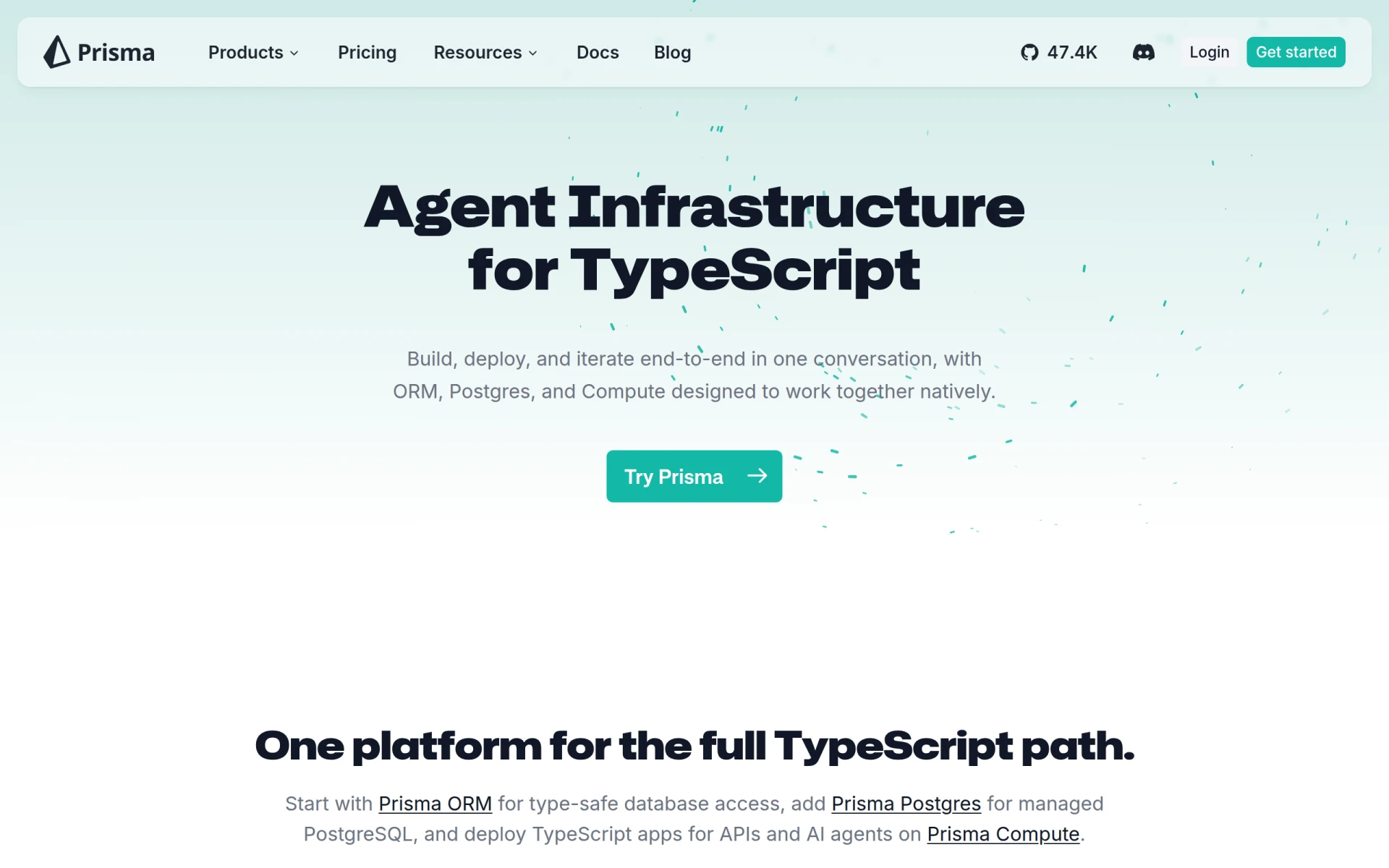
Prisma is a powerful tool designed specifically for developers working with TypeScript and Node.js. It serves as an Object-Relational Mapping (ORM) solution that streamlines database interactions while providing a managed PostgreSQL service. Its primary purpose is to facilitate a type-safe and efficient workflow for developers, significantly reducing the complexity involved in database management and application deployment. By leveraging a schema-first approach, Prisma allows developers to define their data models once and generate the necessary queries and integrations automatically, thereby simplifying the programming process.
Prisma addresses several common problems faced by developers, including the difficulty of ensuring type safety in database queries, the overhead of managing database connections, and the challenges of deploying applications. With Prisma ORM, developers can write less boilerplate code and focus on building features rather than getting bogged down in database management tasks.
Key Features
- Prisma ORM: Type-safe queries generated from your schema.
- Prisma Postgres: Managed PostgreSQL service with built-in connection pooling.
- Schema-first workflow: Define your data models once and generate the necessary code.
- TypeScript support: Seamless integration with TypeScript projects.
- Deployment options: Deploy TypeScript apps easily using Prisma Compute.
- Operation-based pricing: Pay only for the operations you use with Prisma Postgres.
- Community-driven: Built on an open-source foundation with a strong developer community.
- Documentation: Comprehensive resources and guides to facilitate onboarding and usage.
Benefits
Using Prisma provides several practical advantages for developers and teams. First, it enhances developer productivity by reducing the amount of repetitive code that needs to be written. The type-safe queries help eliminate common runtime errors, allowing developers to catch issues at compile time. Additionally, Prisma's managed database offerings simplify the deployment and scaling of applications, helping teams focus on developing features rather than maintaining infrastructure. The integration of SQL and TypeScript encourages better collaboration between backend and frontend developers, ultimately leading to higher-quality software.
Common Use Cases
Prisma can be effectively utilized in various scenarios, including:
- Developing web applications where efficient database access and management are critical.
- Creating RESTful APIs that require seamless integration with a PostgreSQL database.
- Building microservices architectures that need a reliable and manageable database layer.
- Rapidly prototyping applications that leverage TypeScript and require quick iterations.
- Educational projects where students can learn database management alongside TypeScript programming.
Who Should Use It
Prisma is ideally suited for:
- Developers and teams working with TypeScript and Node.js.
- Startups and small businesses needing a fast and efficient way to manage databases.
- Organizations that prioritize developer experience and want to reduce time spent on database-related tasks.
However, it may not be the best fit for:
- Teams that predominantly use other programming languages outside of TypeScript.
- Companies requiring extensive enterprise features that may not be fully supported in Prisma.
Pricing Overview
Prisma ORM is free to use, while Prisma Postgres operates on an operation-based pricing model. Users can start with free tiers and scale as needed based on usage.
Conclusion
Prisma is a robust solution for TypeScript and Node.js developers seeking to enhance their database management and application deployment processes. While it excels in providing a type-safe and efficient development environment, potential users should consider their specific use cases and team requirements to determine if it aligns well with their development practices. Overall, Prisma offers significant value for those looking to streamline their database workflows and improve developer productivity.